


On the surface, football appears to be the ultimate meritocracy. Twenty-two players step onto the same pitch, compete under identical rules, and for the same 90 minutes, they share a common objective: victory. However, once the final whistle blows and the stadium empties, a less visible but equally telling divide emerges. Two players who stood shoulder to shoulder for an entire match can return to vastly different financial realities. AFFA ACHO delves into why footballers on the same field can earn vastly different wages.
In the relentlessly competitive modern game, “talent” is no longer a simplistic, one-dimensional attribute solely defined by how elegantly a player dribbles, how accurately they pass, or how robustly they tackle. Instead, it has evolved into a sophisticated, multi-dimensional asset – one that clubs meticulously measure, strategically value, and, crucially, price accordingly within a globalised market.
To dispel a common, yet pervasive, misconception: playing time does not, in any equitable sense, translate directly into pay equity. Consider the archetypal defensive midfielder, a tireless engine room operative who might cover an astonishing 12 kilometres per game, win ten crucial tackles, and maintain an impressive 90% pass accuracy, dictating the tempo from deep. This unsung hero may, astonishingly, earn a mere fraction of the club’s mercurial star winger, who might spend large stretches of the game seemingly walking, conserving energy, before exploding into three breathtaking seconds of individual brilliance that ultimately decides the outcome of the match.
Why such a profound disparity? Because football wages are fundamentally not a simple reward for effort expended, nor are they a straightforward acknowledgement of consistency. Instead, they are a complex reflection of scarcity, impact, and quantifiable market value.
The most highly compensated players in world football are, almost without exception, those who possess the unique ability to single-handedly transform potential draws into invaluable wins, or impending defeats into hard-fought stalemates. This category includes the prolific striker with an uncanny knack for netting 89th-minute winners, the visionary playmaker who consistently delivers the perfectly weighted, defence-splitting final pass, or the ice-cool goalkeeper who routinely saves crucial penalties in high-stakes cup finals. These elite athletes possess what can only be described as decisive talent. Clubs are prepared to pay an exorbitant premium for players who can, in mere milliseconds, alter the trajectory of a match and, by extension, the club’s fortunes. This is because positive results are the lifeblood that drives revenue: substantial prize money from league competitions, lucrative qualification for prestigious tournaments like the UEFA Champions League, and the burgeoning sales of merchandise and replica shirts.
Commercial Appeal: Beyond the Touchline
However, the modern understanding of talent extends far beyond the confines of the touchline and the immediate action on the pitch. A player’s global following, their expansive social media reach, and their inherent marketability have now become explicit, non-negotiable wage determinants. When a top-tier club invests in signing a global superstar, they are not merely purchasing goals, assists, or clean sheets; they are simultaneously acquiring a potent commercial package. This package includes the guaranteed boost in shirt sales, the activation of lucrative sponsorship clauses, and a significant uplift in digital engagement across various platforms.
Consider a stark example: two players of ostensibly comparable technical ability and on-field performance might exhibit a staggering 500% wage difference. This colossal disparity can often be attributed simply to the fact that one possesses a colossal following of, say, 50 million Instagram followers, while the other, despite his on-field prowess, has a more modest digital footprint. In this increasingly commercialised landscape, a player’s commercial talent directly subsidises, and often justifies, their astronomical salary. They are, in essence, revenue-generating assets both on and off the pitch.
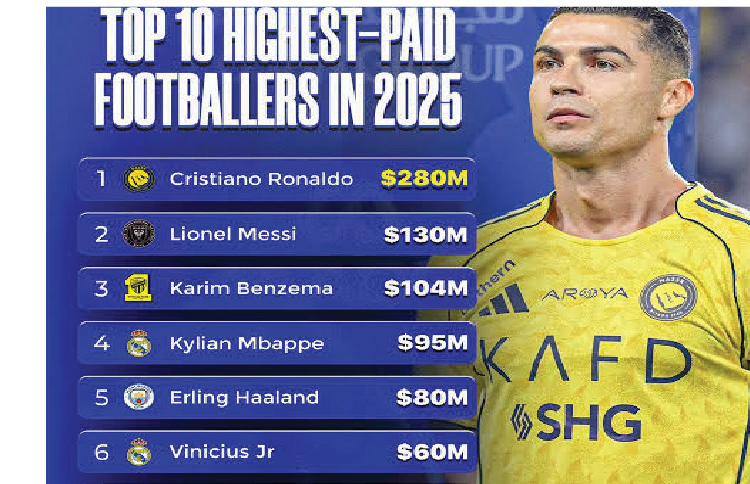
As of April 2026, Cristiano Ronaldo remains the highest-earning footballer globally, with total annual earnings estimated at approximately $280 million. His income is primarily driven by his contract with Al Nassr and extensive off-field endorsements. Lionel Messi follows in second place, while other top earners include Karim Benzema and Kylian Mbappé.
Supply, Demand, and Positional Value
Furthermore, it is an undeniable truth that not all positions on a football pitch are remunerated equally. The law of supply and demand, a fundamental economic principle, plays a pivotal role within the unique ecosystem of the transfer market. A truly reliable, left-footed centre-back with exceptional aerial ability and composure on the ball is an infinitely rarer commodity than a hard-working, yet perhaps less distinctive, central midfielder. Similarly, an elite ‘number 9’ striker who can consistently guarantee 25 league goals a season is considerably harder to unearth than a functional, dependable full-back.
Wages, therefore, are a direct reflection of this scarcity. If a club possesses the internal capacity to replace a particular player with a promising youth academy graduate at a mere 10% of the cost, that player’s wage demands will, understandably, remain modest. However, if replacing a key player would necessitate an €80 million transfer fee and a protracted, six-month global search for a suitable alternative, their agent holds immense leverage in salary negotiations. The club, faced with the prospect of significant disruption and expenditure, is often compelled to meet the player’s demands to retain their services.
The Market Value of Talent
The disparity in wages can largely be attributed to the fact that football salaries are not rewards for effort or even consistency; they are reflections of scarcity, impact, and market value. The most highly compensated players are the ones who can single-handedly turn draws into wins. A striker known for scoring late goals, a playmaker delivering critical assists, or a goalkeeper making crucial saves in high-stakes matches—these athletes possess a decisive talent that commands a premium in the market.
Clubs recognise that results drive revenue: the potential for prize money, Champions League qualification, and merchandise sales hinges on the performance of these key players. Thus, the financial stakes are higher for those who can impact a game in a split second.
The Uneven Locker Room
Consider a hypothetical mid-table Premier League club. On matchday, three players take to the pitch for the same 90 minutes: Player A Homegrown Full-Back-£25,000 per week. Reliable and hardworking, yet easily replaceable given the presence of two other players who can fill his role.
Player B: Creative Midfielder – £90,000 per week. Inconsistent but capable of moments of magic—a defence-splitting pass or a curling free kick. This player is currently being monitored by three other clubs.
Player C :Star Striker – £250,000 per week. Scored 18 goals last season, wears the captain’s armband, and has a personal boot sponsorship that sells out globally.
All three players were on the pitch for the full 90 minutes and contributed to the team’s result. Yet, Player C’s talent is rarer, more decisive, and commercially valuable than that of Player A. This disparity is not a reflection of unfairness; rather, it is market economics applied to sport.
The Psychological Cost of Wage Disparity
Such wage differences do not come without their challenges. Locker rooms are complex social ecosystems, and players talk. When a new signing arrives earning triple the wages of a club veteran who has dedicated years to the team, resentment can easily fester.
Talented managers like Jürgen Klopp and Pep Guardiola recognise the importance of managing “wage hierarchy.” They strive to ensure that top earners justify their pay through leadership and performance, while lower earners feel valued through opportunities for development and respect.
Maintaining Balance in the Locker Room
The healthiest clubs maintain a transparent logic: wages are not about favouritism but about market forces. As one sporting director once remarked, “We don’t pay players for what they did yesterday. We pay them for what they can do tomorrow that almost no one else can.” This perspective fosters a culture where players understand their worth is tied to their unique contributions.
The Broader Implications of Wage Disparity
The debate over wage disparity in football is unlikely to fade anytime soon. Critics often argue that such disparities contribute to a fractured team spirit or create an environment of discontent. However, understanding the logic behind these wage structures—rooted not in fairness but in talent economics—helps fans separate emotion from reality.
While the pitch may be level, the pay slip rarely is. Football, like any other industry, operates on principles of supply and demand, market value, and individual contribution. Players who can deliver match-winning performances or draw in substantial commercial revenue will always command higher salaries.
Looking Towards the Future
As football continues to evolve, the conversation around wages will likely shift. Issues such as financial fair play, player welfare, and equitable treatment are gaining traction. Yet, the fundamental principles of talent valuation will remain integral to the sport. Clubs must navigate the delicate balance of rewarding talent while fostering a cohesive team environment.
The world of football wages is a complex interplay of talent, marketability, and economic principles. While it may seem unfair that players on the same team can earn vastly different amounts, this reality reflects the intricacies of a sport that transcends mere physical prowess.