


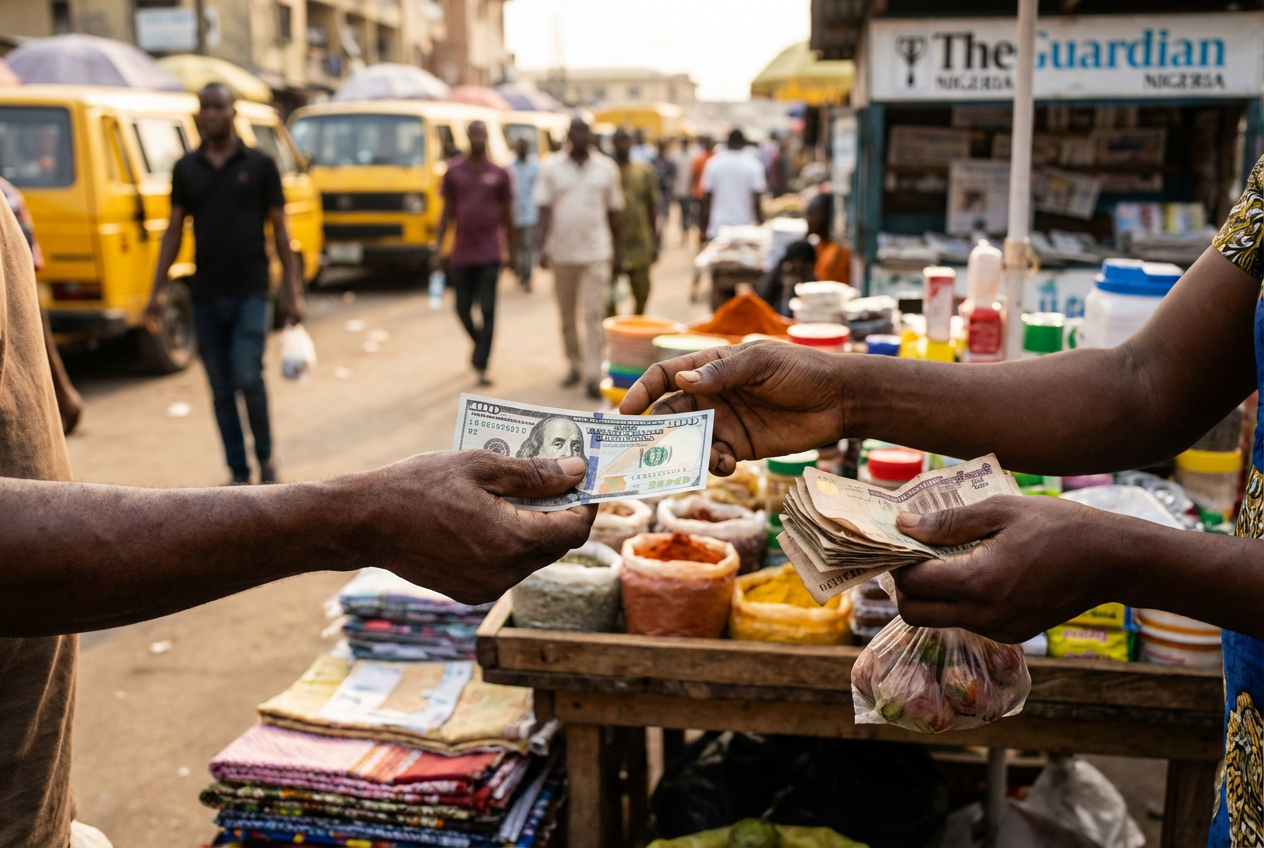
In markets, offices, real estate deals, and even casual conversations, a quiet but powerful shift is reshaping Nigeria’s economic life. Increasingly, prices that once lived comfortably in naira are now mentally, and sometimes officially, tied to the U.S. dollar.
From rent payments and school fees to imported food, cars, electronics, and luxury services, many Nigerians feel as though they are living in a country where the naira exists, but the dollar decides the real price of everything.
This phenomenon, often described by economists as informal dollarization, has accelerated in recent years as Nigeria battles inflation, currency depreciation, and persistent economic uncertainty.
For millions of Nigerians, the result is a daily reality where salaries are paid in naira, but expenses increasingly behave as if they were calculated in dollars.
What Dollarization Really Means
Dollarization occurs when a foreign currency begins to dominate a country’s economy, either formally or informally.
In Nigeria’s case, the process is largely informal but deeply embedded in economic behavior.
Businesses still accept naira for most transactions, but prices are frequently determined by the current dollar exchange rate.
This means when the naira weakens, the price of goods and services often rises almost immediately.
In practice, many Nigerian businesses now operate with an unofficial formula:
Dollar price × exchange rate = Nigerian price
The result is an economy where the naira no longer determines value; it merely reflects it.
Why the Naira Keeps Losing Ground
To understand the spread of dollar pricing across Nigeria, one must start with the steady decline of the naira.
Over the past decade, the Nigerian currency has faced repeated pressure from several factors:
- heavy dependence on oil exports
- limited foreign exchange inflows
- high import dependence
- inflation and fiscal deficits
- global economic shocks
Nigeria imports a large share of the goods it consumes, from refined petroleum and machinery to pharmaceuticals and food products.
When a country relies heavily on imports, the value of its currency becomes tightly linked to the availability of foreign exchange, particularly the U.S. dollar.
Whenever dollars become scarce, the naira weakens.
When the naira weakens, the cost of imported goods rises.
And because imports sit at the heart of Nigeria’s supply chains, those price increases quickly spread across the entire economy.
Real Estate: The Sector Where Dollar Pricing Became Normal
One of the clearest examples of Nigeria’s quiet dollarization can be seen in the property market.
In cities like Lagos, Abuja, and parts of Port Harcourt, high-end rents and property prices are increasingly quoted in dollars.
Landlords often calculate rent based on what the property would be worth in dollar terms.
Tenants may still pay in naira, but the amount required is often adjusted according to the prevailing exchange rate.
For example, a landlord who considers an apartment worth $10,000 per year may simply convert that figure into naira at the current rate.
When the naira weakens, the rent rises.
For tenants earning salaries that rarely adjust at the same pace, this dynamic has made housing significantly more expensive.
Education Costs Are Now Tied to the Dollar
Another area where Nigerians feel the pressure of dollarization is education.
Many private schools and universities, particularly international schools, calculate tuition based on the dollar.
Parents often discover that school fees rise dramatically whenever the naira depreciates.
Even schools that charge officially in naira often adjust their fees to account for imported educational materials, foreign staff salaries, and operational costs tied to international markets.
For families already facing rising living costs, the dollarization of education adds another layer of financial strain.
Imported Goods: The Hidden Driver of Price Increases
Nigeria’s dependence on imports plays a major role in the spread of dollar-based pricing.
A significant portion of consumer goods sold in Nigerian markets, including electronics, vehicles, pharmaceuticals, and packaged foods, are imported or rely on imported components.
When importers bring goods into the country, they pay suppliers in dollars.
If the exchange rate rises, their costs rise immediately.
Those higher costs are then passed along to wholesalers, retailers, and ultimately consumers.
This is why everyday Nigerians often notice that prices in markets seem to change overnight whenever the exchange rate shifts.
In effect, many products sold in naira are simply dollar-priced goods converted into local currency.
The Rise of the “Dollar Mindset”
Beyond formal pricing structures, dollarization has also created a psychological shift.
Many Nigerians now instinctively think about the value of money in dollar terms.
Entrepreneurs often measure profits in dollars.
Property investors evaluate real estate prices in dollars.
Freelancers and digital workers seek clients who pay in dollars.
Even casual conversations about financial success increasingly revolve around dollar income.
This mindset reflects a deeper reality: in an unstable currency environment, people naturally gravitate toward a more stable store of value.
For many Nigerians, the dollar has become that reference point.
How Young Nigerians Are Responding
One of the most striking developments in recent years is how younger Nigerians are adapting to this economic environment.
A growing number are actively seeking income streams tied to foreign currencies.
Common strategies include:
remote work for international companies
freelancing on global platforms
digital services such as design, writing, and marketing
online businesses targeting global customers
For many young professionals, earning in dollars has become a form of financial protection against inflation and currency depreciation.
This trend has contributed to the rapid growth of Nigeria’s digital workforce and remote economy.
The Impact on Businesses
For Nigerian businesses, the dollarization trend creates both opportunities and challenges.
Companies that depend on imported materials face constant uncertainty because their costs can change rapidly with exchange rate movements.
Many businesses now adjust prices frequently to avoid losses.
This environment makes long-term planning difficult and often pushes companies to hold cash reserves in dollars rather than naira.
Some businesses even maintain offshore accounts or dollar-denominated savings as a hedge against currency risk.
Inflation and the Cost of Living Crisis
The spread of dollar-linked pricing has played a major role in Nigeria’s rising cost of living.
When prices follow the dollar, inflation can accelerate quickly during periods of currency depreciation.
Food prices, transportation costs, and household expenses can all increase in rapid succession.
For ordinary Nigerians whose incomes are fixed in naira, this creates a widening gap between earnings and expenses.
The result is a growing sense of financial pressure across many households.
The Diaspora Connection
Nigerians living abroad play an important role in this evolving financial landscape.
Every year, billions of dollars flow into Nigeria through remittances sent by diaspora workers.
For many families, these remittances act as a financial lifeline.
Because the money arrives in foreign currency, it often retains more purchasing power than local earnings.
This has further reinforced the perception that the dollar holds stronger value than the naira.
Can Nigeria Reverse the Trend?
Economists argue that reversing informal dollarization requires strengthening the fundamentals of the local currency.
Key factors include:
increasing foreign exchange earnings
diversifying exports beyond oil
improving domestic manufacturing
stabilizing inflation
If the naira becomes more stable and predictable, businesses and consumers may gradually return to pricing decisions based primarily on local currency.
However, such structural changes take time.
Until then, the dollar will likely continue to influence many aspects of Nigeria’s economic life.
A New Financial Reality
For now, Nigeria appears to be living through a period where the naira functions as the country’s official currency, but the dollar quietly shapes many economic decisions.
Prices may still be written in naira, yet the calculations behind them often begin with the dollar.
For households struggling with rising living costs, businesses navigating volatile exchange rates, and young professionals seeking financial stability, the influence of the dollar is impossible to ignore.
In practical terms, many Nigerians have already adjusted to this reality.
The country may not be officially dollarized.
But in daily life, from rent negotiations to online freelance payments, the dollar has become the invisible yardstick of value.
And until the naira regains stronger stability, that silent dollar takeover is unlikely to fade anytime soon.
Read also
The Shocking Reason Get-Rich-Quick Investment Schemes Keep Winning in Nigeria
How to Spot Fake Investment Platforms Before Losing Your Money in Nigeria
10 Costly Mistakes Nigerians Make When Buying Land (And How to Avoid Property Scams)
Treasury Bills vs Fixed Deposits in Nigeria (2026): Which Investment Pays Higher Returns Right Now?
Is Nigeria Still a Smart Investment in 2026? Opportunities, Risks, and the Real Economic Outlook
12 Side Hustle Scams Nigerians Must Avoid in 2026 Before You Lose Your Hard-Earned Money