


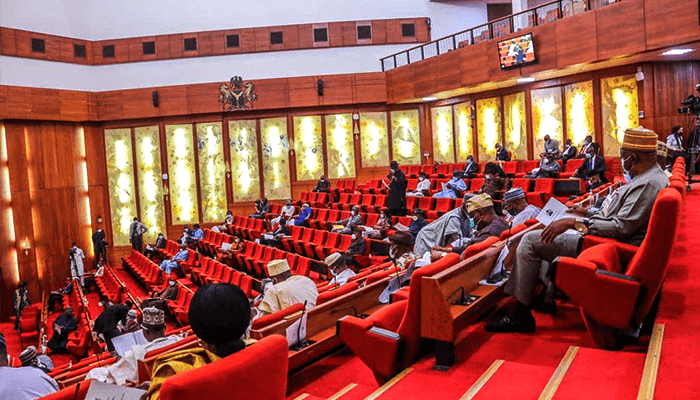
Days after rejecting an amendment to explicitly provide for electronic transmission of election results in the Electoral Act (Amendment) Bill, 2026, the Senate yesterday reversed itself and adopted a revised provision mandating electronic transmission of results from polling units to the Independent National Electoral Commission’s (INEC) Results Viewing Portal (IReV).
However, it stopped short of approving real-time transmission, providing instead that where electronic transmission fails due to network or technical challenges, Form EC8A shall serve as the primary means of collation and declaration of results.
The resolution followed the consideration and approval of a motion moved by the Chief Whip of the Senate, Mohammed Tahir Munguno, during an emergency plenary session in Abuja.
This came days after the Senate, while adopting the report of its Committee on Electoral Matters on February 4, 2026, retained the provision of the 2022 Electoral Act, which merely allows for the transfer of election results, without specifying whether it is electronic or real-time transmission.
That decision triggered widespread public outrage, with civil society organisations, opposition political parties, activists and election stakeholders staging protests and accusing the legislature of attempting to weaken electoral transparency.
In response, the Senate leadership announced that lawmakers would reconvene from their brief break from plenary to attend budget defence sessions and to address the matter.
On Monday, pressure intensified when a coalition of civil society groups and activists, led by former Labour Party presidential candidate, Peter Obi, stormed the National Assembly complex, demanding the immediate inclusion of electronic transmission of election results in the amended law.
During plenary yesterday, while adopting the votes and proceedings of February 4, 2026, lawmakers formally corrected Clause 60(3) of the bill, which deals with the transmission and collation of election results.
After a voice vote, the amendment was adopted as the official position of the Senate. Moving the motion, titled, “Motion for rescission on Clause 60(3) of the Electoral Act, 2022 (Repeal and Enactment) Bill, 2026,” Munguno said the Senate was empowered under Orders 1(b) and 52(6) of the Senate Standing Orders, 2023 (as amended), to reconsider its earlier decision.
His motion read in part: “The Senate recalls that the Electoral Act (Repeal and Enactment) Bill was passed by the Senate on Wednesday, February 4, 2026; notes that upon careful examination of the bill, fresh issues have emerged in respect of Clause 60(3), which requires further legislative consideration in order to ensure the conduct of smooth, transparent and credible elections in Nigeria.
“Accordingly, the Senate resolves to rescind its earlier decision on Clause 60(3) of the Electoral Act (Repeal and Enactment) Bill as previously passed and recommit Clause 60(3) to the Committee of the Whole for further reconsideration and passage.”
Senate President Godswill Akpabio, while presiding, read out the revised amendment before putting it to a vote. “The clause being debated provides that presiding officers shall electronically transmit the results from the polling units to INEC’s IReV portal and that if the electronic transmission fails and it becomes difficult to transmit the results, Form EC8A shall be the primary means of collation,” Akpabio stated.
Munguno, in his contribution, said electronic transmission would enhance speed, accuracy and accountability in election result management, adding that the amendment resolves earlier controversy over the ambiguity between transfer and transmission of results.
“This amendment ensures clarity, transparency and credibility in our electoral process,” he said.
The motion was seconded by Senator Abdul Ningi (PDP, Bauchi Central) and passed by voice vote, with the majority of senators supporting the revised clause.
However, the session became rowdy at some point, as Enyinnaya Abaribe called for a division of the Senate, a request he later withdrew.
In a related development, the Senate also expanded its membership of the conference committee on the Electoral Bill Amendment, 2026, increasing its representation to 12 members to match that of the House of Representatives, in a move aimed at speeding up harmonisation of differences between both chambers.
Simon Lalong Bako retained his position as chairman of the Senate conference committee, with Mohammed Tahir Munguno, Adamu Aliero, Orji Uzor Kalu, Abba Moro, Asuquo Ekpenyong, Iya- Abass Aminu, Adetokunbo Abiru and Adeniyi Adegbomire, as members. Three other senators, Jibril Isa Echocho, Banigo Ipalibo Harry and Peter Nwaebonyi were added to the committee.
In his remarks, Akpabio stressed the urgency of the committee’s assignment, noting that its work should be concluded within a few days, or at most, a week to enable the transmission of the bill to President Bola Tinubu for assent within February.
“This is a matter of urgency. If the committee concludes its work quickly in some days or a week, the President should be able to sign the amended Electoral Bill into law this month,” Akpabio said.
Meanwhile, the Senate President received a correspondence from Mr President seeking the confirmation of Usman Dakingari as a non-career ambassador.
The request was referred to the Committee on Foreign Affairs for further legislative action.