


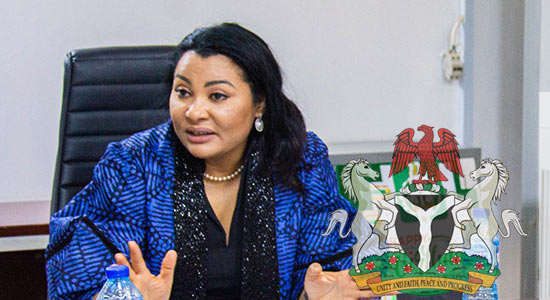
The Minister of State for Finance, Dr Doris Uzoka-Anite, on Wednesday said Nigeria must sustain annual economic growth of between 10 and 12 per cent over the next decade to achieve the $1tn economy target set by President Bola Tinubu.
Uzoka-Anite, who was represented at the 2026 Annual General Meeting of the Finance Correspondents Association of Nigeria in Abuja by the Assistant Director of Information and Public Relations at the Federal Ministry of Finance, Mrs Uloma Amadi.
In her goodwill message, the minister said, “Nigeria’s GDP currently sits at approximately $375bn. To reach $1tn requires sustained GDP growth of between 10 and 12 per cent annually over the coming decade.”
She described the $1tn economy agenda as “a specific, measurable destination,” adding that the administration was pursuing structural reforms aimed at laying the foundation for long-term expansion.
According to her, when the current administration assumed office in 2023, Nigeria’s economic fundamentals were “structurally distorted,” citing fuel subsidy payments of over N5tn annually and a multiple exchange rate regime that, she said, encouraged rent-seeking and weakened investor confidence.
She noted that in January 2026, S&P Global Ratings revised Nigeria’s outlook to positive while affirming its B-/B credit ratings, citing improvements across fiscal, monetary and external indicators.
On fiscal management, Uzoka-Anite said the Federal Government had restructured the budget framework to treat investment expenditure as a distinct pillar, separate from recurrent spending.
“For the first time, we are treating investment expenditure as a distinct pillar of public finance, separate from recurrent spending. This matters because it disciplines government to ask a different question: not just how much are we spending, but what are we building with what we spend,” she said.
She disclosed that the second phase of reforms is anchored on the Disinflation and Growth Acceleration Strategy, jointly developed by the Ministry of Finance and the Central Bank of Nigeria.
The strategy, she said, is built on a nine-pillar implementation framework aimed at delivering non-inflationary growth of over seven per cent by 2027.
The pillars include capital mobilisation through development finance instruments; sectoral acceleration in agriculture, energy, technology, manufacturing and creative industries; and a nationwide energy expansion programme spanning oil, gas, solar, hydro and emerging fuels.
She also listed digital infrastructure expansion, including broadband and AI-ready data centres; a human capital pipeline targeting over 10 million young Nigerians annually in technical and vocational programmes; and an expanded Consumer Credit Platform designed to improve access to structured financing for housing, education, healthcare and household goods.
Uzoka-Anite said Nigeria currently imports about 70 per cent of the raw materials used for industrial production, a development she described as limiting the country’s control over its long-run cost structure.
She pointed to the Dangote Refinery as an example of domestic value addition, arguing that processing raw materials locally would boost job creation, tax revenue and household incomes.
On Nigeria’s international standing, the minister said the country’s removal from the Financial Action Task Force grey list last year reflected strengthened anti-money laundering and counter-terrorism financing frameworks.
She added that Nigeria had submitted its ECOWAS Tariff Offer to the African Continental Free Trade Area Secretariat, establishing zero duties on 90 per cent of goods traded within the continent.
In a related development, the Ministry of Finance Incorporated unveiled details of a N1tn private sector-driven programme to transform Nigeria’s mortgage market and address structural constraints in the housing sector, with the National Coordinator of the Ministry of Finance Real Estate Investment Fund, Sani Yakubu, disclosing that N75bn has already been deployed following the successful raising of an initial N250bn tranche.
Yakubu described the housing market as facing a “life or death” supply gap, noting that developers often struggle to secure funding because lenders question off-take viability, adding, “The toughest question developers face is: who is going to buy the houses? By giving an off-take guarantee, we stand ready to provide mortgages to Nigerians to buy those units, making developers more bankable.”
He said the scheme offers mortgages at 9.75 per cent interest for up to 20 years, with a 10 per cent equity contribution, and has facilitated an average of N10bn monthly since March 2024 through 20 participating institutions, including Sterling Bank, Stanbic IBTC Bank and Infinity Mortgage Bank, while citing AG Mortgage Bank’s N6.7bn mortgage processing under the initiative as exceeding its total output in the 21 years prior.
Yakubu added that the N1tn programme, registered with the Securities and Exchange Commission and structured for execution in tranches, is supported by a digital platform listing about 5,000 housing units nationwide to deepen financial intermediation, expand transparency and provide a sustainable framework for affordable housing delivery.
Also speaking at the forum, the Vice President of the Nigeria Infrastructure Fund at the Nigeria Sovereign Investment Authority, Abraham Durosawo, who represented the NSIA Managing Director and Chief Executive Officer, Aminu Umar-Sadiq, said Nigeria would require annual infrastructure investments of between $100bn and $150bn to close its deficit and support the $1tn economy target.
Durosawo said the authority was driving key projects through the Presidential Infrastructure Development Fund and stressed that “it takes a village to deliver this $1 trillion economy,” explaining that infrastructure financing must combine PIDF resources, tax credit schemes, private capital and state-led interventions.
He added that while some legacy road projects were reviewed due to funding controls and policy adjustments, a broader review of the national infrastructure strategy was ongoing to ensure sustainability and value creation.
On energy, he said the NSIA’s partnership with the Rural Electrification Agency was aimed at attracting capital into renewable projects to provide power to millions of Nigerians currently off-grid, and urged deeper engagement with financing structures deployed by institutions such as the Bureau of Public Enterprises and the Infrastructure Concession Regulatory Commission to address long-standing development gaps.