


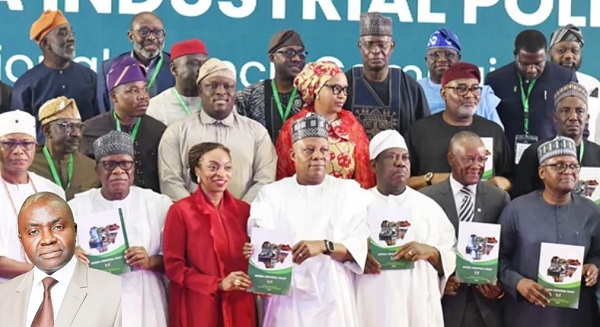
In what has been described in some quarters as a game-changer, President Bola Tinubu last Tuesday, unveiled a new industrial policy for the country with a charge to relevant ministries, departments and agencies (MDAs) of government to ensure speedy implementation.
The policy, arguably a roadmap for re-engineering Nigeria’s industrial base, unlocking value across sectors, and placing production, competitiveness, and jobs at the centre of the nation’s economic strategy, has already established a clear implementation architecture.
Speaking during the official launch of the Nigeria Industrial Policy 2025 at the Bola Ahmed Tinubu International Conference Centre, Abuja, the president, who was represented by his deputy, Vice President Kashim Shettima, lamented the fact that Nigeria has grappled “with fragmented value chains, high production costs, infrastructure gaps, policy inconsistency, and insufficient coordination between government and industry.”
“We have realised that industrialisation is not a wish you think about; it is an action you perform. More than that, we must remind ourselves that this task demands coherence across energy, trade, infrastructure, finance, skills, and innovation. It requires partnership between government and the private sector,” he stated.
President Tinubu insisted on timely implementation and execution of the policy, noting that when his administration came on board in 2023, it did so with a promise to redefine Nigeria’s industrial ambition.
He said, “The defining strength of this policy is its insistence on implementation. This administration will not measure success by the number of documents we produce. “We will measure success by the number of factories that open their gates at dawn, by the jobs created for our young men and women, by the exports that leave our ports bearing the mark of Nigerian excellence, and by the value retained within our own economy.”
While enumerating key aspects of the policy, the president said it prioritises strategic sector focus anchored on the nation’s comparative and competitive advantages.
“It advances value chain development so that Nigeria moves steadily from exporting raw materials to producing finished goods. It integrates our micro, small, and medium enterprises into the heart of industrial growth, because prosperity must not be exclusive.
“It aligns infrastructure and energy with industrial ambition, for factories cannot run on policy alone. It strengthens skills, technology, and innovation to prepare our people for the industries of today and tomorrow.”
While urging private sector participation, the president sought support for the sector “to invest with confidence and responsibility, to deepen local value chains, to create jobs and transfer skills, and to partner with the government in building a productive economy.”
President Tinubu commended the Minister of State for Industry, John Enoh, “for his disciplined leadership and clarity of purpose in driving” the process, adding that the minister “has demonstrated that policy leadership is not about noise, but about substance, coordination, and follow-through.”
He also applauded the ministry’s technical teams, industry stakeholders, manufacturers, investors, and practitioners for shaping the “policy into a document grounded in reality and informed by experience” with their insights.
Earlier, the Minister of State for Industry, John Enoh, said the campaign marked a turning point aimed at building an industrial Nigeria that produces, competes, and prospers.
Echoing similar sentiments, business mogul and Chairman of Dangote Group of Companies, Aliko Dangote, commended the federal government for introducing a progressive industrial policy, observing that Nigeria is the only country in Africa where the private sector is bigger than the government.
Mr Dangote said domestic manufacturers are pleased with the policy the Tinubu administration has created, expressing firm belief that “the naira, this year, will be at ₦1,000 to $100.”
Announcing that many investors are willing to invest in Nigeria due to FX stability and other reforms, Mr Dangote suggested that the only thing remaining is the protection of indigenous industries, saying “if there is no protection, there is no way any industry will thrive here.”
On his part, the United Nations Resident and Humanitarian Coordinator in Nigeria, Mohamed Fall, expressed confidence that, with the official launch of the policy, Nigeria has taken a step into its future where hope is turned into action, resulting in inclusive economic growth.
He explained that the policy is the outcome of an ongoing partnership between the United Nations Industrial Development Organization (UNIDO) and Nigeria, aimed at transforming the country into a beacon of prosperity and a key player in regional and global value chains.
Also, the President of the Manufacturers Association of Nigeria (MAN), Francis Meshioye, commended the president over the launch of the policy, noting that manufacturers are focused on the effective implementation of the policy.
He backed the promotion of indigenous entrepreneurship enshrined in the policy, assuring that MAN will give its full support to ensure its successful implementation.
The formal unveiling follows earlier assurances by the federal government in August 2025 that a comprehensive industrial policy was being finalised to curb Nigeria’s heavy reliance on imported goods.
The initiative was led by the Ministry of Industry, Trade and Investment in collaboration with the Manufacturers Association of Nigeria.
The policy is aimed at reversing Nigeria’s dependence on imports by strengthening domestic manufacturing capacity.
It is designed to deepen value addition across key sectors and boost export-led growth.
The government has indicated that the framework will significantly raise manufacturing’s contribution to the economy over the next five years.
Further push for new industrial policy
Expectedly, there has been a serious push for the new policy regime with top government officials leading the charge.
Fielding questions from a select crop of journalists during an interface and discussion session in Lagos, recently, the Minister of State for Industry, Trade and Investment Senator John Owan Enoh stated matter-of-factly that the new industrial policy is going to be different from the previous industrial policies.
“When you talk about previous industrial policies, I mean, the difference is that this particular policy is big on implementation and it’s big on execution. I mean, this policy starts with an appreciation of what the problem is and sets out to provide, you know, solutions to these problems. I mean, this policy was crafted with the recognition that policy has never been a problem to our country. What has continued to be a problem has been, after the policy, what next?
“So this policy understands that it’s not policy for the sake of policy. It’s a policy for what we can achieve for the country. And therefore, so much effort has been spent, you know, trying to fashion out an implementation framework that can get this policy to work. Which is why, even far ahead of the formal launch of this policy, we’ve spent a lot of time, we have a lot of sessions, trying to make sure that we get the implementation right. Because we want to celebrate only after what impact this policy is able to achieve for the country industrially, not just because we have a policy document. I mean, it’s clear in terms of timelines, in terms of responsible people, who are those responsible for what, in terms of alignment with the sub-nationals.
“I mean, at the time we were doing validation of the policy, when it was still in grant form, we had representations from the Nigerian Governors Forum, from associations of local government, and other stakeholders because ultimately, this policy is for the country. It’s not just for the ministry alone. When I was posted as Minister of State for Industry, I mean, I was shocked when, in a session with the Manufacturing Association of Nigeria, they had never been consulted in any of the policies that had come out in terms of industry. So this policy has the ministry and various stakeholders, including the organised private sector, you know, taking part and getting it to where it is, development partners, everybody has had a buy-in to this policy. You know, so there is this strong hope that, and optimism, that this policy will deliver and truly be different.”
The minister, who acknowledged that certain challenges are being identified as part of the effort to frame this policy, stressed that power supply is key in the whole scheme of things.
“What I can say for free is that very early, we have recognised the fact that the big elephant in the room was power. It was power. And power is one of the five thematic areas that the Industrial Revolution workgroup that I chair and co-chaired by the President of Manufacturers Association of Nigeria (MAN), identified. And after that identification, one of the things we have decided is that in going forward, we’re going to inaugurate ministerial roundtables. And that the first and only ministerial roundtable that we’ve had to hold has had to do with the roundtable dealing with power, security, and infrastructure. And, you know, as the roundtables are intended to be modelled, each of these roundtables brings together people who have solutions to that particular constraint in the room. And hope that by the time we get to that roundtable, at least we’ve started solving that problem. You know, so when we organised the roundtable on energy, we had the Power Minister in the room.
“We had the Nigeria Electricity Regulatory Commission in the room. We had the Nigerian Midstream and Downstream Petroleum Regulatory Authority (NMDPRA) in the room. We had all of these players. We had people playing in the gas ecosystem in the room. And there was identification and realisation and conclusion that to solve the power challenge, we need to talk about blended power. You know, we need to talk about a mixed combination between grid power, power from gas and then from renewables and all of that. And that all of this is going to get together to get us to make sense and to make progress in dealing with the power challenge.”
Also speaking in an interviewy, the Director General, Manufacturers Association of Nigeria (MAN), Segun Ajayi-Kadir backed the recently launched National Industrial Policy (NIP), describing it as fundamentally different from previous frameworks and capable of doubling the real sector’s contribution to national output in a decade.
Unlike previous policies, Ajayi-Kadir said the policy stands out because it was co-created with stakeholders and backed by a clearly-defined implementation plan.
He said the Ministry of Industry, Trade and Investment fully engaged manufacturers and other stakeholders in shaping the document.
“We had a wide range of stakeholders, not just MAN, but other development partners and agencies of government. So, it was inter-ministerial in its determination.”
Related News
Proliferation of BAT support groups: Sifting the grain from chaff
Tinubu felicitates Air Chief Aneke, Zinox boss on birthday
Re-electing Tinubu ‘ll sustain current national reform trajectory – APC chieftain
Ajayi-Kadir said another key departure from past policies is the inclusion of a detailed implementation framework.
“What we have also done that is different in this one is that it is matched by an implementation plan, which shows clear timelines, who is supposed to do what, when and more importantly, how success will look like from the beginning,” he said.
He disclosed that the policy sets a 10-year target to significantly raise the industrial sector’s contribution to the gross domestic product.
“It is a 10-year period within which we will have advanced manufacturing to a stage where we go beyond the nine per cent, 10 per cent contribution to GDP to as high as 20to 25 per cent,” he stated.
He added that the creation of the Industrial Revolution Working Group by the ministry has further strengthened confidence in the framework.
Ajayi-Kadir said the policy clearly defines the scope of the industrial sector and identifies manufacturing, oil and gas, construction and mining as the core industries. He explained that fiscal incentives and financing will be directed strategically at the areas.
“Government’s primary focus is to direct attention to those sectors, the incentives, drivers, requirements for finance and infrastructure and what is needed to promote integration into the global economy,” he said.
Noting that the food and beverage industry is a strong growth area, he said: “We know that the food and beverage sector in the country has been a promising one because, as they say, we must all eat. It is important that we take advantage of our population and also the fact that Nigeria is a blessed country.”
The MAN DG also underscored the importance of innovation and technology, noting the advancement among young people in the use of technology and AI to drive raw material sourcing and knowledge about market access in other economies.
While reacting to the government’s aspiration to achieve a $1 trillion economy in five years, Ajayi-Kadir said while it was good to be ambitious, it was a technically attainable goal over the long term.
He noted that achieving the target was not a matter of arithmetic growth or wishful thinking.
“It demands a strategic transformation of the economy’s foundational structure, particularly the industrial sector,” he said. With the newly-rebased nominal GDP at $245 billion, the DG said reaching the $1 trillion threshold by 2030 would require constant nominal growth of 12–14 per cent yearly, assuming currency stability or real GDP growth of 6–7 per cent per year, a figure that is nearly twice the 3.38 per cent growth recorded last year.
Ajayi-Kadir said a growth path that merely expands the size of low-productivity sectors, such as informal trade and consumption-driven services, would only deepen inequality, reinforce economic vulnerability and perpetuate jobless growth.
“To make a credible path to a $1 trillion economy not by wishing it to happen, requires a deliberate and strategic revival of industrial output, with particular focus on high-value-added and exportable manufactured goods supported by unmitigated government patronage.”
A reliable and affordable energy supply must be central to this effort. Without stable and cost-effective electricity, the manufacturing sector cannot thrive and contribute meaningfully to the GDP.”
The MAN DG said it is equally critical to upgrade core infrastructure such as transport networks, logistics systems and broadband connectivity to support efficient production and regional trade integration.
“A coherent, investor-friendly policy environment across fiscal, trade and monetary domains is also essential to attract and retain long-term capital,” he noted. He also urged the government to boost productivity across strategic subsectors such as agro-processing, textiles, pharmaceuticals and light engineering, where industrial linkages and employment potential are strongest.
“Strengthening the naira, curtailing inflation and ensuring inclusive, sustained growth must be central to any credible path toward this milestone,” he said.
Divergent views
In the view of Matthew Okey, it is anybody’s guess how the new industrial policy will turn out. “With the benefit of hindsight, since gaining independence in 1960, Nigeria has implemented over a dozen major industrial policies and strategies with industrial trajectory shifting from state-led import substitution to, more recently, private-sector-led, technology-driven, and export-oriented strategies. However, not many would argue that there is nothing to cheer about considering the rather poor outcomes with most of these policies.”
While noting that the-who-is-who in the nation’s political landscape yet again converged in Abuja to unveil a new National Industrial Policy last Tuesday with lots of panache and fanfare, Okey argued that it is most certain that the new policy document will go the way of others: ending up in the archives!
How to drive industrialisation policy
For Dr Muda Yusuf, renowned subject matter expert in macro and micro economics, what drives industrialisation policy is not just mere rhetoric but well-intentioned programmes of action by everybody involved in the ideal and idea of socioeconomic development.
Speaking in an exclusive interview with our correspondent against the background of the new National Industrial Policy regime, the one-time Director General of the Lagos Chamber of Commerce and Industry (LCCI), gave a very dispassionate view about to turn the tide for good as far as a marshal plan for driving economic progress.
Going down memory lane, he recalled that, “Nigerian industrialisation journey has been shaped or influenced by the various policy frameworks that we have had over the years. It has also been influenced largely by the macro economic conditions and it has been influenced significantly by the structural environment.”
Expatiating, Dr Yusuf, who is the Founder/ CEO of the Centre for the Promotion of Private Enterprise ( CPPE), an organisation committed to the ideals and ideas of free enterprise, said, “From a policy perspective, between independence and up until the 70s, I think the emphasis of industrial policy was on import substitution. In the 60s, we had a bit of resource-based industrialisation when we had industries that were dependent on domestic sourcing of raw materials largely. At that time, we had agro-island industries. We had textile industries that were dependent on domestic cotton. We had the rubber industry that depended on our rubber plantation and all of that. But the import substitution strategy took root, became more pronounced in the 70s up until the 80s before we had the structural adjustment programme. The import substitution strategy was anchored largely on our capacity to provide foreign exchange to import raw materials. So that policy regime depended largely on imported raw materials. I think that is where we missed it largely because we built an industrial structure that was highly import dependent. That made our industrial sector very vulnerable.”
According to him, “When we had the crash in oil prices in the early 80s to mid-90s, we ran into a serious problem with our industrial sector. Ever since then, we have not actually recovered because we now had an industrial sector that was highly import dependent that was highly vulnerable to external shocks. So each time we had a challenge with foreign exchange, we had a challenge with our manufacturing sector. And of course, that was clearly not an industrial policy model that was sustainable. So the fact that we had a highly import dependent industrial sector became one of the major challenges of industrialisation in Nigeria.”
READ ALSO: Ogun govt disowns alleged Awujale endorsement, halts selection process
He was however quick to admit that between the 80s to the 90s and 2000, saw some gradual shifts to resource-based industrialisation.
“In other words, we saw industries that were leveraging domestic resources to be able to build industrial enterprises. I’m talking about domestic raw materials, local raw materials. So that is what led to the growth of cement industries, led to the growth of our food and beverage sector, to some extent our furniture industry, and of course, oil and gas related industries. Those were largely resource-based industries, and that is why as we speak today, most of the segments of the manufacturing sector that have been thriving are those that are sourcing raw materials substantially locally. So they are more competitive and they are less vulnerable to external shocks. So the undoing of the Nigerian manufacturing sector over the years has been the high import dependence.”
Another major drawback for industrialisation is the structural environment, he stressed, adding that “industrialisation is highly intensive in the use of infrastructure. Industrialisation is energy intensive. Industrialisation is also intensive in its dependence on logistics. So because over the years, we have not invested sufficiently in our key infrastructure, particularly power and energy and logistics, the infrastructure deficit has been worsening progressively from the 70s through the 80s to the 90s to 2000 and even up until now. And without the appropriate infrastructure, it is extremely difficult to talk about any major breakthrough in industrialisation, no matter how beautiful the industrial policy is.”
Yusuf, feels strongly that “If we don’t address the fundamental issue of infrastructure, we cannot build a competitive industrial sector. Because the beauty of industrialisation is not just to target the domestic market, it’s also to be able to export to the sub-region, to the continent, and even beyond the continent. All the countries that have industrialised look beyond their domestic markets.
“And we cannot compete outside our shores if we continue to produce under the present condition of high energy costs, high logistics costs, high regulatory burden, high cost of funds. These are major structural issues. So no matter how beautiful the industrial policy is, we don’t fix these structural issues. We cannot make much progress. And it’s noteworthy that at the launch of the industrial policy, Alhaji Aliko Dangote alluded to this point, that the fundamental criteria for advancing industrial development is the provision of power. That is very basic. We cannot build something on nothing. The fundamentals must be right. If the power is right, and we have an industrial policy that focusses on resource-based industrialisation, that leverages available resources, those resources could be mineral resources, it could be agricultural resources, it could even be human resources. But the beauty of competitiveness is for you to leverage your competitive advantage. So for me, that is the way to go. And that is what can create a competitive industrial sector for the Nigerian economy.”
The renowned economist reiterated the fact that those managing the levers of the economy must ensure that the right macro environment is in place .
“We need to ensure that we have the right kind of funding for agriculture in terms of the long-term funds and the lower cost of credits. So the term of funds and cost of funds is important. We need to ensure the right kind of logistics to support industrialisation. And we need to build heavy industries that can allow us to backward integration. And this will require some government support. For instance, if we are talking about iron and steel to support the automobile industry, we have to invest heavily in iron and steel with the support of government. I’m not saying government should begin to run industries, but government has to support some heavy industries.
“These are heavy industries that are necessary. If we want to make progress in cables, wire, and the rest of them, we need to support the aluminium smelter industry. We need to support our plastic industry, packaging industry. We need to support petrochemicals. We need to support packaging, publishing, and all of that. We need to support our pulp and paper industry.
“These are heavy industries that we need to be able to support the light industries so that we have as much as possible significant level of backward integration. That is where our competitiveness will come from. So those are the things. And of course, we need to fix our structural environment. We need to support the energy situation. We need to support an improvement in our logistics. For me, if we don’t address these fundamentals, it will be difficult to make the kind of progress that we are planning to make.”
The success of the Nigeria Industrial Policy 2025, analysts stressed, will largely depend on effective implementation, policy coherence, and the resolution of structural constraints, particularly in the power sector, which industry leaders say remains the backbone of any meaningful industrial transformation.