


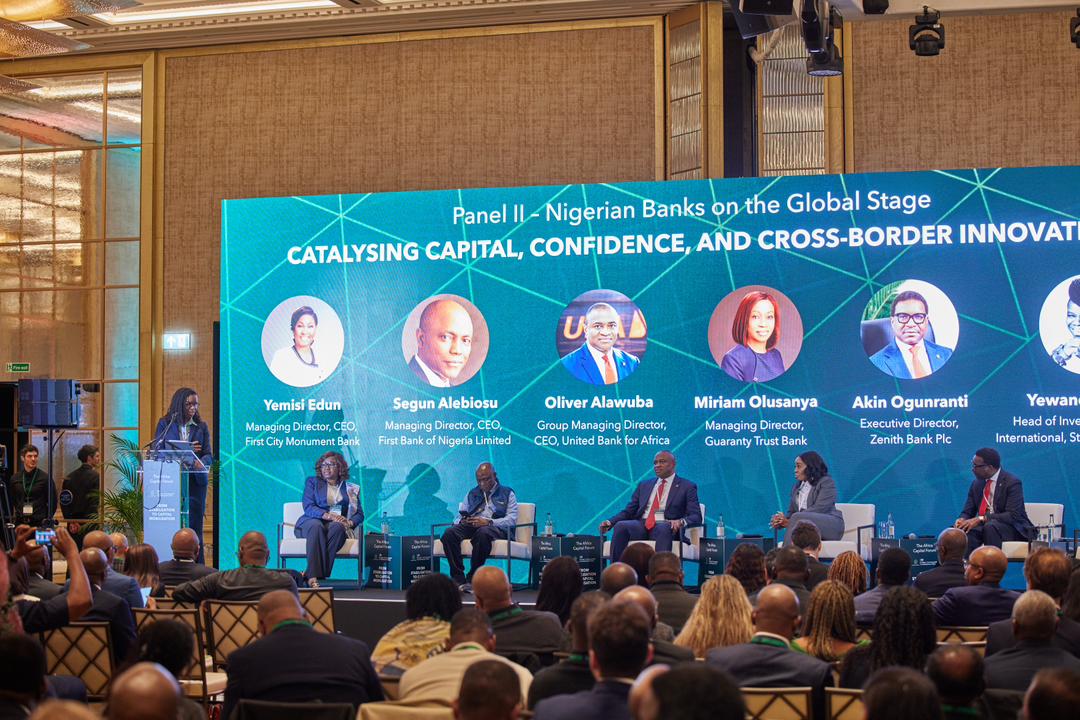
With 32 banks meeting new capital requirements and 72 per cent of funds raised domestically, Nigeria’s banking sector emerges from its most significant reform cycle as the primary engine of the country’s capital mobilisation agenda
LONDON — When Nigeria’s banking recapitalisation exercise was announced, the debate centred largely on compliance: which banks would meet the threshold, and by when. At The Africa Capital Forum’s inaugural convening in London on Tuesday, the conversation had moved on entirely. The question was no longer whether Nigeria’s banks could recapitalise. It was what a recapitalised Nigerian banking sector could now do for a $1 trillion economy.
The answer, according to the chief executives who gathered at The Peninsula London alongside President Bola Ahmed Tinubu’s UK state visit, is considerable.
Akin Ogunranti, Executive Director of Zenith Bank, set the tone early. “We need to give ourselves credit,” he told delegates. “The fact that over 72 per cent of the capital was raised locally is a major milestone.” That figure carries weight beyond optics. It signals that Nigerian capital markets are deepening, that domestic investors have confidence in the banking sector’s trajectory, and that the foundation for long-term growth is being built from within.
CBN Governor Olayemi Cardoso was direct about what the sector has become. “We are very proud of what the Nigerian banks have been able to accomplish,” he said. “They play a dominant role on the African continent and in the United Kingdom. They are our ambassadors.” Thirty-two banks have now met the CBN’s new capital requirements, and Cardoso described the system that has emerged as categorically different from what preceded it. “The financial system we had is dead and buried. What we have now is a new system that has brought liquidity and transparency.”
The implications for the broader economy were spelled out across the afternoon’s sessions. Yemisi Edun, Managing Director of First City Monument Bank, noted that recapitalisation had directly expanded the credit available to businesses: “The raised capital has created expansion of credits. The new recapitalisation has given more credibility to what we can do as industries.” Segun Alebiosu, Managing Director of First Bank, made the international dimension explicit. “With currency reforms, Nigerian banks will be able to take home bigger transactions. We can do more, and crowd new investments.” He added that Nigerian banks today maintain at least seven operations in the United Kingdom alone.
The scale of Nigerian banking’s continental footprint was perhaps most vividly illustrated by Oliver Alawuba, Group Managing Director of UBA, who noted that over 65 per cent of the bank’s revenue now comes from outside Nigeria. “That means that we can do more in Africa,” he said.
That outward reach is not incidental to the $1 trillion economy agenda. It is central to it. Miriam Olusanya, Managing Director of Guaranty Trust Bank, pointed to the restoration of correspondent banking relationships as a structural shift: “The confidence has been restored and corresponding banking relationships will continue to grow.” Those relationships determine Nigeria’s ability to facilitate cross-border trade, attract foreign investment, and participate in the global capital markets at the scale a $1 trillion economy requires.
Sanyade Okoli, Special Adviser to the President, framed the government’s position plainly: “The government alone cannot fund this growth. We need to work with partners who will bring the sticky, equity capital.” A recapitalised, internationally credible banking sector is how that partnership becomes possible.
Governor Cardoso closed by placing the banking sector’s transformation within its broadest context. “This is perhaps the first time in many years that we’ve had this level of consistent stability,” he said. “And it is likely to stay on course.”
The Africa Capital Forum was convened by the Central Bank of Nigeria in partnership with the UK Foreign, Commonwealth and Development Office and hosted by BBC News Presenter Lukwesa Burak. It was supported by Access Bank, FCMB, First Bank, Goldman Sachs, GTCO, J.P. Morgan, Nigerian Exchange Group, UBA, and Zenith Bank.
ENDS
The Africa Capital Forum is an independent institutional convening platform dedicated to advancing strategic dialogue on capital mobilisation, financial system development, and investment into Africa. The Forum convenes senior leaders from global financial institutions, development finance organisations, central banks, and the private sector to examine the policy and market conditions shaping Africa’s economic trajectory.