


The revelation comes from a new investigative report exposing how vulnerable young men were lured abroad with false promises of employment and educational opportunities, only to be forced into military service.
Russia-Ukraine war
At least 36 Nigerians were reportedly enlisted to fight in Russia’s ongoing war against Ukraine, with five confirmed dead.
The disclosure stems from a recent investigative report detailing how vulnerable young men were enticed overseas with deceptive promises of jobs and educational prospects, only to be conscripted into military service.
The report, titled, ‘The Business of Despair: The Russian Army’s Recruiting of African Fighters’ was published in February 2026 by the investigative group, All Eyes on Wagner.
The research document detailed how Russia, after its invasion of Ukraine in February 2022, allegedly turned to African nations to bolster its ranks.
The report, drawing on a database of 1,417 African recruits between 2023 and mid-2025 obtained from Ukrainian sources, identifies Nigerians as part of a broader strategy in which foreign fighters are deployed as “cannon fodder” in high-risk assault operations.
The average age of African recruits is 31, and many were reportedly drawn from economically challenged backgrounds.
Among confirmed Nigerian fatalities are Abdoulaye Issaka Ismael, 27; Agbo Moses Omale, 43; Adamu Abdulai Ismail, 25; Mikael, 47; and Fajobi Taiwo Omoniyi, 50.
The report said the death toll —316 across all African recruits— might be higher, as the list is not exhaustive and additional deaths were identified through social media verification.
The investigation by the OSINT Accountability Project uncovered networks recruiting African fighters for Russia, including travel agencies in both Russia and Africa advertising “fast-track procedures.”
The agencies were alleged to have collaborated with recruiters based in Russia, who reach potential recruits through social media and messaging platforms, mainly Facebook, Instagram, Telegram, and TikTok, using videos and photos showcasing life in Russia against the backdrop of Moscow skyscrapers or luxury cars, symbols of wealth, power, and success.
The OSINT report showed that Nigeria is among the countries targeted, alongside South Africa, Ghana, Kenya, Uganda, Cameroon, and Gambia.
It noted that recruits were often deceived through social media adverts and travel agencies offering discounted flights and work opportunities, only to be coerced into signing military contracts upon arrival.
According to the report, the offers are highly attractive, with signing bonuses of several thousand dollars, base monthly salaries of $2,000 to $2,500, higher for “specialists”, health insurance, and even facilitated access to Russian citizenship once the contract is completed.
It noted that, however, in practice, many of the promises remain unfulfilled as fighters on the ground, as well as those who managed to leave, report unpaid wages, funds siphoned off by recruiters or superiors, or payments far below what was originally promised.
In 2025, Ukraine’s Foreign Minister, Andrii Sybiha, raised the alarm when he disclosed that more than 1,400 nationals from 36 African countries were fighting for Russia, with many currently held in Ukrainian camps as prisoners of war.
Some Nigerians have been caught in the trap
Families of affected Nigerians, particularly from southern states like Rivers and Ogun, expressed grief and outrage.
An unnamed Nigerian man captured by Ukrainian forces while fighting for Russia, recounted the circumstances that led to his conscription.
Speaking in a video posted on X, the man said his phone was confiscated as he was forced to sign a contract in Russia without understanding its content.
He said he had believed he was being trained for work in his field, undergoing an intensive one-week course followed by another two-week programme, only to be abruptly sent to the battlefront.
He also recounted the case of another Nigerian, identified as Abubakar, who suffered a heart-related episode during training and was hospitalised for five days.
He said upon recovery, Abubakar realised he was being forcibly conscripted and refused to obey orders.
Despite signing documents agreeing to a three-month jail term with the promise of eventual return to Nigeria, he was still sent to the frontline without proper training.
The Nigerian said he does not know Abubakar’s current whereabouts.
Days back, one Abubakar Adamu appealed to the Federal Government through his legal representatives for urgent intervention to secure his repatriation from Russia, claiming he was lured into the army under the guise of a civilian security job.
According to a publisher, Zagazola Makama, Adamu’s lawyers informed Nigerian authorities that he travelled to Moscow on a tourist visa issued on October 16, 2025, by the Russian Embassy in Abuja, believing he would work as a security guard.
Upon arrival, his travel documents were reportedly confiscated, and he was compelled to sign enlistment papers written in a Russian language without an interpreter.
Only later did he discover he had been enlisted in the Russian military.
In a formal petition submitted to Nigerian authorities, Adamu’s legal team invoked the doctrine of Non Est Factum, arguing he did not understand the nature or implications of the documents he was made to sign.
They also alleged misrepresentation and coercion, claiming he was lured into military service under false pretences.
According to the lawyers, Adamu is currently being held in a Russian military camp and has refused deployment to combat zones in Ukraine.
They demanded that Russian authorities should halt any deployment, return his seized documents, and facilitate his safe return to Nigeria.
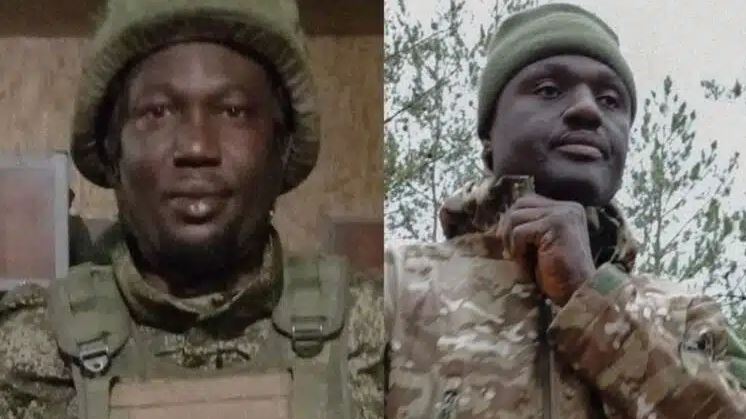
On Thursday, February 12, 2026, the Ukrainian Defence Ministry released photographs of two Nigerians, Hamzat Kazeem Kolawole and Mbah Stephen Udoka, reported to have died while fighting for Russia in Luhansk.
Kolawole had signed a contract to join the Russian military in August 2025, while Udoka enlisted on 28th September of the same year.
Both men had no military training and reportedly died during an attempt to storm Ukrainian positions.
A key recruitment hub in Nigeria is alleged to be St. Fortunes Travels and Logistics, a Port Harcourt, Rivers State-based agency run by one Fortune Chimene Amaewhule.
Established in December 2022, the firm was alleged to have openly advertised Russian army enlistment on social media and billboards, promising quick benefits such as citizenship and high salaries.
The agency was also said to have provided Nigerian and Russian contact numbers and was linked to persistent campaigns targeting jobseekers.
Earlier this week, the Russian Ambassador to Nigeria, Andrey Podyolyshev, denied claims that Moscow was recruiting Nigerians to fight in the Russia–Ukraine conflict.
Speaking in Abuja, he said he was not aware of any government-backed programme to enlist Nigerians and added that if such activities were occurring, Russia had no involvement.
“If anybody has this information, we are ready to send it to Russian law enforcement authorities so they can investigate those cases,” he said.
Repatriation completed in 2023 – NIDCOM
Reacting, the Federal Government said its repatriation exercise for Nigerians affected by the Russia–Ukraine conflict concluded more than three years ago, insisting that those who remained in Russia deliberately enlisted in the military after renouncing their Nigerian nationality.
Spokesperson for the Nigerians in Diaspora Commission, Abdulrahman Balogun, while commenting on the case of Adamu, said, “The Federal Government finished repatriation over three years ago. He deliberately enlisted himself in the army, and to do that, he must have renounced his Nigerianess.”
The Ministry of Foreign Affairs did not respond to requests for comment on the findings of the report.
Nigerians are greedy – Alleged enlistment agency
Also reacting to the allegation against his company, Amaewhule denied recruiting Nigerians to fight as mercenaries in Russia.
He said his firm had previously handled a Russia-related travel package but discontinued it after receiving what he described as credible information that some Nigerians were switching from legitimate work-related visas to enlist in the Russian army upon arrival.
Amaewhule explained that prospective recruits were enticed with financial incentives allegedly offered by recruiters, including promises of citizenship, a $30,000 signing bonus and weekly payments of about $3,000.
“Because of that, we had to stop,” he said.
According to him, the package his company offered was not linked to the Russian military.
“It was for teaching, and even that was for Kazakhstan. The two countries are very close, and there is a strong demand for English teachers there,” he said.
Amaewhule added that aside from Kazakhstan, his firm had not taken any clients directly to Russia, stressing that no one was recruited before the package was suspended.
He said around the time the company halted the package, some clients began requesting assistance to work with the Russian army, requests he said were declined.
The travel agent also recounted the case of a client who travelled to Kazakhstan through his firm and later contacted him about military recruitment opportunities.
According to Amaewhule, the client, whom he did not know personally and who had been referred by a family friend, asked the intermediary to speak to him about joining the army.
“I told the woman we would never allow anyone to switch,” he said, adding that he appealed to the family to dissuade the man.
Amaewhule further stated that he gathered more information about the recruitment pipeline through another client whose relatives, based in Qatar, had moved to Russia.
“Through him, I began to understand the process, how they were approached and what was being offered,” he added.
Amaewhule acknowledged that some Nigerians who initially travelled to Kazakhstan on student or work visas later crossed into Russia to join the military, a development he said might have created the impression that his company was involved.