


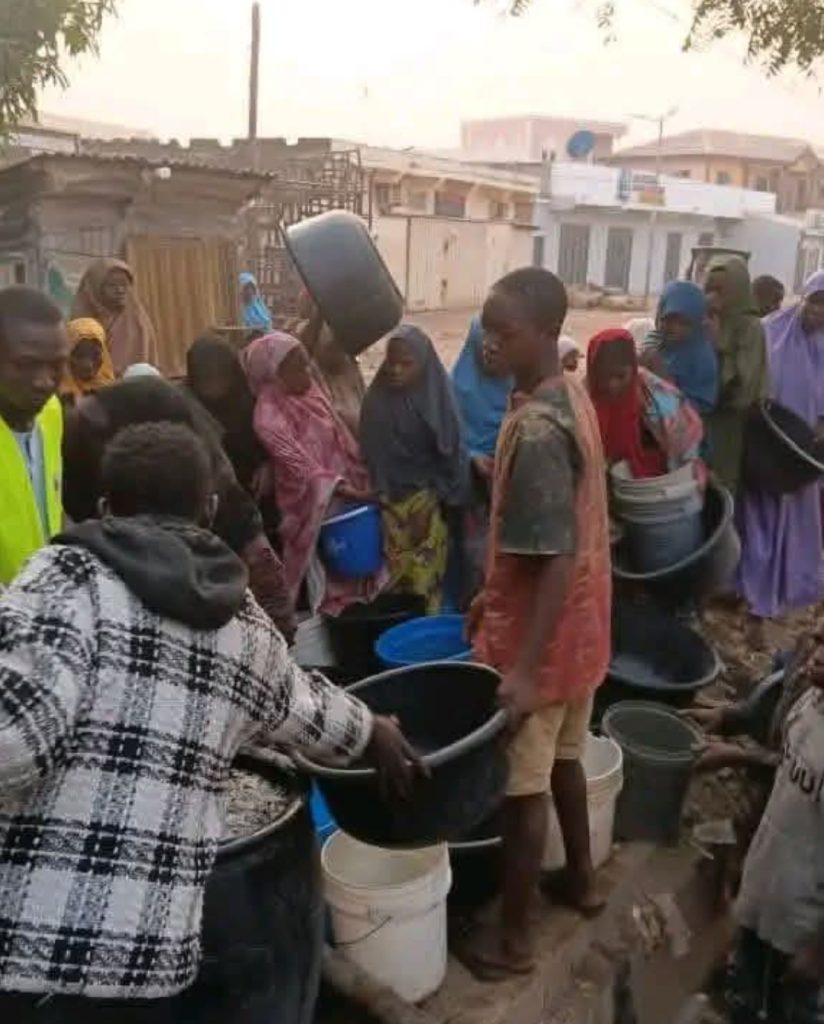
Every morning at about 5 am in Tunga, Minna, women line up with buckets and jerrycans. They are not early for work or school.
They are early in response to rumours that water might flow. Most mornings, nothing comes, but hope keeps households awake long before dawn.
Across Minna and Suleja and other major towns, water no longer runs from taps. It comes through scrambling, bargaining, and spending.
What was once a public service has quietly transformed into a survival economy. Families that used to depend on utility supply now spend thousands of naira weekly on water. To drink, cook, wash and bathe have become luxury routines rather than basic rights.
When supply fails, disorder replaces routine. Children skip school to fetch water, traders delay opening shops, clinics ration usage, and mosques and churches struggle with sanitation.
In Bosso, Tunga, Kpakungu, Chanchaga, Morris, Barkin-Sale, Maitumbi and several other parts of the state capital, residents say public supply can disappear for two weeks or more while others don’t even get supply at all and when it comes briefly, people rush with containers, pushing and shouting, afraid the flow may vanish again within minutes.
“Sometimes you see adults fighting over water like children. If I don’t buy water, I don’t cook. Some days I spend more money on water than on ingredients.
“Customers complain, but they don’t know what we go through just to wash plates and keep our place clean, ” said Aisha Sadiq, a food vendor in Tunga.
The crisis has also reshaped household economics as a truck of water now sells for between N2,000 and N3,500 depending on the location.
A bag of sachet water goes for about N300, forcing families to ration drinking water.
Residents recalled that in December 2025, a truck of water was sold between N800 and N1000, but the dry season and collapsing public supply have pushed prices even higher.
Private borehole owners have become mini water lords and in some neighbourhoods, residents queue with jerrycans for hours.
When power fails and pumps stop, the queues freeze, tempers rise and hygiene collapses.
Suleja faces similar hardship. In recent weeks, residents complained of combined electricity and water failure, crippling homes, businesses and schools.
A statement circulated by concerned citizens warned leaders that patience was wearing out.
“We are deeply disappointed by the continuous lack of electricity and water in Suleja. Life has become very difficult for ordinary people.
“Businesses are suffering, students cannot study well, and families are struggling to meet their daily needs. These basic necessities are our rights, not privileges,” the statement read, as residents hinted at a peaceful rally if conditions persist.
Yet the crisis feels ironic. Niger State is one of Nigeria’s richest water landscapes. It hosts the legendary River Niger and River Kaduna, alongside major hydro facilities at Kainji, Shiroro, Jebba and Zungeru dams that generate electricity for large parts of the country.
In the midst of this natural abundance, residents still battle daily for basic household water while turbines spin at Shiroro, taps in Minna, Suleja and other towns remain dry, forcing households into a daily contest with scarcity and cost.
Beyond the rivers and dams, Niger State also has waterworks in Chanchaga, Bosso, Suleja, Bida, Kontagora and New Bussa, originally designed to supply potable water for domestic and commercial use.
Engineers and residents say these facilities now operate far below capacity due to aging equipment, broken transmission lines, vandalism and population growth that has outpaced planning.
Engr Tobi Adeolu, who understands the original Minna water network, said the problem is not only decay but destruction caused by urban construction.
According to him, “The original galvanized pipes laid in the 1980s were stronger, but during road and bridge construction, many contractors had no proper mapping of the network.
“They damaged the major arteries, and in many places asphalt has already been poured on top of them. Once that happens, repair becomes expensive and technically difficult.
“Apart from that, with urban population growth, a lot of areas in Minna have not yet been reticulated despite huge funds allocated for that.”
He explained that scavengers later vandalised exposed sections, worsening losses.
“Some of the damage is already sealed under roads. So you are building a city on broken arteries. Even if water is produced, it cannot reach homes,” Engineer Adeolu added.
He further warned, “without mapping the original network and coordinating construction with water engineers, new investments will repeat old mistakes. You cannot fix water by accident. You must understand the arteries of the city first,” he said.
Observations also show that new pipes are being laid around areas like the Zenith Bank axis in Minna, but residents question their durability compared with older systems.
Many residents fear the cycle of replacement without planning will repeat failure, adding that the water economy now favours vendors, private boreholes owners over citizens, scarcity over planning, survival over comfort.
Managing Director of the Niger State Water and Sewage Corporation, Engr. Gimba D. Yisa, acknowledged that road construction damaged key transmission pipelines feeding Minna.
Through the corporation’s Public Relations Manager, Zainab Yunusa, NISWASEC said tankers were being deployed to cushion the impact while engineers work on repairs.
The Commissioner for Water Resources and Dams Development, Alhaji Yahaya Alhassan Gwagwa, also blamed vandalism and illegal connections for sabotaging infrastructure, warning that offenders would be prosecuted.
Residents, however, insisted that tanker deployment is a temporary relief, not a solution to a collapsing system.
The roots of today’s crisis also stretch back decades. Former Governor Abdulkadir Abdullahi Kure (1999–2007) purchased ductile pipes worth billions of naira to reticulate water across the 25 local governments in the state, however, while some were buried, others were left exposed and later vandalised.
It was revealed that even those buried in the ground have been allegedly unearthed by suspected hoodlums in some LGs and sold to scavengers.
His successors continued with water promises.
Under Dr. Mu’azu Babangida Aliyu (2007–2015) and Abubakar Sani Bello (2015–2023), water supply featured prominently in policy documents and budgets.
In 2019, Niger State allocated about N13.7 billion to the water sector for rehabilitation and expansion of schemes. Officials also disclosed that over N3 billion was spent across several years on boreholes, pumps, generators and revival of waterworks.
Under the current administration of Governor Mohammed Umaru Bago (2023–date), about N5.2 billion was earmarked in the 2024 fiscal plan for water supply projects, including drilling rigs and urban interventions.
Yet residents argue that spending has not translated into stable household delivery.
Analysts say investments in Niger State’s water sector have often focused on short-term fixes rather than system-wide reform.
They noted that boreholes increased across communities, yet transmission pipelines weakened just as pumping stations were revived. New roads disrupted vital water arteries, all without coordinated mapping.
The result is a parallel water economy and during the dry season, vendors capitalise on scarcity, selling at rates many families describe as exploitative.
With no alternative, households pay more, even if it means cutting food budgets. Water scarcity has also become a public health issue, as even at hospitals, hygiene now competes with availability.
A nurse working at the Minna General Hospital, who would not want the name mentioned, said patient care is already affected as the dedicated line to the hospital no longer supplies water.
“We ration water for cleaning, washing hands and basic sanitation. Some patients’ wounds heal slower, infections rise, and families sometimes bring their own water because ours runs out. This is a daily struggle we cannot ignore,” she said.
Also, disturbed by the acute water scarcity, the legislative arm raised alarm.
The Niger State House of Assembly recently urged the Executive to implement emergency water measures across Minna and major towns.
Speaker Rt. Hon. Abdulmalik Mohammed Sarkin-Daji said the crisis threatens health, sanitation and social stability, directing that resolutions be transmitted for urgent action, including borehole rehabilitation, temporary water trucking and long-term infrastructure planning.
He described the situation as unacceptable for a state capital and warned that delays could trigger social and health emergencies.
Sarkin-Daji then directed that the Assembly’s resolutions be transmitted to the Executive for urgent action.
For many residents, however, the crisis is no longer about inconvenience but dignity as children miss school to fetch water, traders close shops early and families negotiate hygiene with scarcity.
Engr Adeolu warns that without urgent system-wide repair, pipeline mapping, and protection of infrastructure, every new road project will silently destroy another water artery beneath it.
Health workers are already seeing the consequences and citizens are already paying the price.