


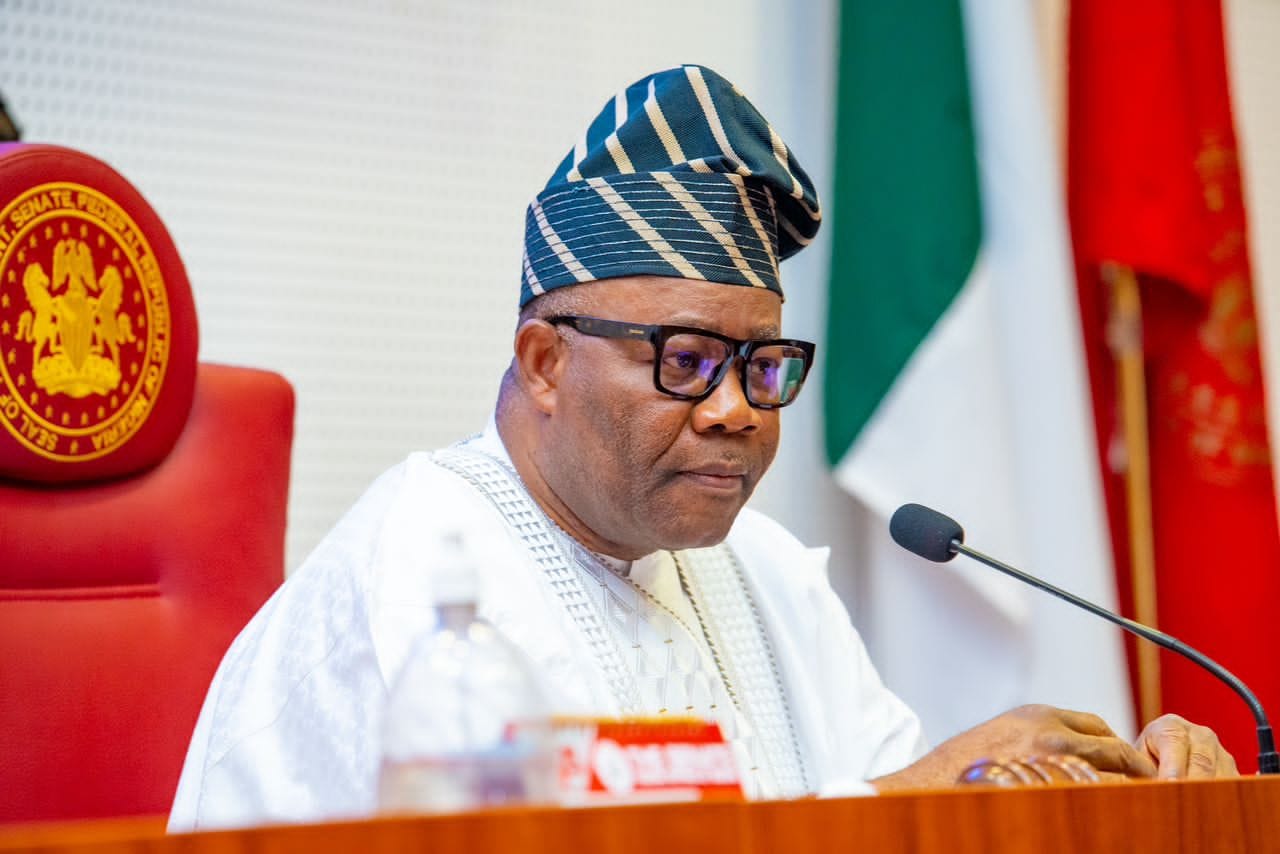
The Senate on Monday assured President Bola Tinubu of its readiness to collaborate with the Executive to ensure the timely passage and effective implementation of the 2026 Appropriation Bill.
News360 Info reports that the pledge was made by the President of the Senate, Godswill Akpabio, during a public hearing and interactive session on the 2026 budget organised by the Senate Committee on Appropriations at the National Assembly, Abuja.
Represented at the event by the Deputy Senate President, Senator Barau Jibrin, Akpabio reiterated the upper chamber’s commitment to its constitutional roles in oversight, accountability and legislative support aimed at stabilising the economy and improving national welfare.
He said, “The Senate remains fully committed to its constitutional responsibility of oversight, accountability, and legislative support for policies that stabilise the economy, unlock productivity, and improve the security and welfare of our people.
“We will continue to work with the Executive and all stakeholders to ensure that the 2026 Budget is not only passed on time, but implemented with fidelity and measurable results.”
Delivering a speech titled “From Budget to Impact,” Akpabio described the budget process as a moment of national introspection, warning against treating it as a routine legislative exercise.
“Budget hearings are not mere rituals of governance. They are moments of national self-examination, occasions when a nation pauses to ask itself hard questions: Where are we? Where are we going? And are our resources aligned with our aspirations?” he queried.
He noted that Nigeria was at a critical economic crossroads, battling inflation, infrastructural decay, rising unemployment, and persistent insecurity, challenges he said are felt daily by citizens across the country.
“These are not abstractions. They are not theoretical projections. They are the daily realities felt in homes, markets, farms, factories, and streets across our land,” he said.
Despite the difficult outlook, the Senate President struck an optimistic tone, urging a shift from traditional budgeting to more impactful fiscal planning.
Quoting British economist John Maynard Keynes, Akpabio said, “The difficulty lies not so much in developing new ideas as in escaping from old ones.
“Our task, therefore, is not simply to spend more, but to spend better; not merely to allocate funds, but to convert budgets into outcomes and appropriations into impact.”
He listed fiscal discipline, tax reform, macroeconomic stability, infrastructure delivery and effective implementation as interconnected pillars for Nigeria’s recovery and growth.
Akpabio also lauded the Appropriations Committee for opening the budget process to public scrutiny, describing it as a hallmark of democratic accountability.
He further stated, “By opening this process to public scrutiny and expert engagement, the Committee affirms a core democratic principle: that budgeting in a democracy is not done for the people alone, but with the people.”
He urged stakeholders, experts, and citizens present at the hearing to participate actively and constructively, saying their input is essential.
“Your insights, critiques, and recommendations are not interruptions to governance; they are its oxygen. Engage not as spectators, but as partners in national progress,” he stated.
Akpabio closed his remarks by reminding participants that a budget reflects the values and priorities of a nation and must translate into real improvements in the lives of the people.