


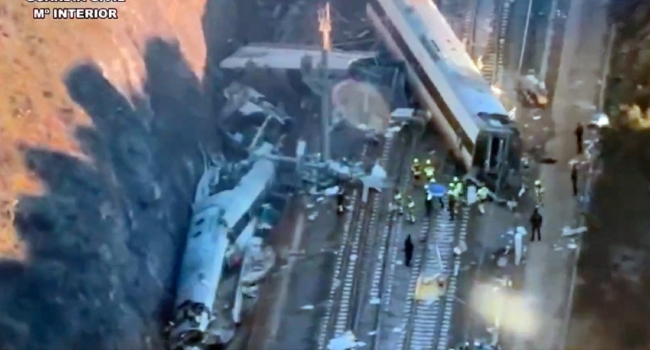
A high-speed train has derailed and been hit by another in southern Spain killing at least 39 people and injuring more than 120, authorities said on Monday.
It said the country’s worst train crash in over a decade was “extremely strange”.
This was the deadliest train accident since 2013, when 80 people died after a train veered off a curved section of track outside the northwestern city of Santiago de Compostela.
The crash happened on Sunday evening when a train operated by rail company Iryo travelling from Malaga to Madrid derailed near Adamuz in Andalucia.
It crossed onto the other track, where it crashed into an oncoming train, which also derailed.
Transport Minister Oscar Puente said at least 39 people died, warning this toll was “not definitive” and could still rise.
“I want to express my deepest gratitude for the tremendous work of the rescue teams throughout the night, under very difficult circumstances,” he added on X.
Around 123 other people were injured, including five very seriously and 24 seriously, the interior ministry said.
Unlike the 2013 accident, the derailment took place on a straight part of the track which had been completely renovated, Puente told reporters.
The first train to derail was “practically new”, making the accident “extremely strange” and “very difficult to explain”, he said.
Rail experts “are very surprised by this accident”, he added.
‘Hard, tricky work’
Train operator Iryo said the locomotive was built in 2022 and last inspected on January 15, adding it “veered onto the adjacent track for still unknown reasons”.
The company said around 300 people were on board its service from the Andalucian city of Malaga to the capital, Madrid.
Renfe, the operator of the second train, has not said how many passengers were on the service, which was travelling to the southern city of Huelva.
Spain has Europe’s largest high-speed rail network, with more than 3,000 kilometres (1,800 miles) of dedicated tracks connecting major cities including Madrid, Barcelona, Seville, Valencia and Malaga.
Emergency services said they struggled to free the hundreds of passengers trapped in the wreckage.
“The problem is that the carriages are twisted, so the metal is twisted with the people inside,” Francisco Carmona, head of firefighters in Cordoba, told public broadcaster RTVE.
“We have even had to remove a dead person to be able to reach someone alive. It is hard, tricky work,” he added.
A passenger on the second train who gave only her first name, Montse, told Spanish public television the train, jolted, “came to a complete stop and everything went dark”.
She described being thrown around in the carriage at the back end of the train and seeing luggage tumble onto other passengers.
“The attendant behind me hit her head and was bleeding. There were children crying,” she added.
“Luckily, I was in the last car. I feel like I was given a second chance at life.”
‘Great suffering’
Survivor Lucas Meriako, who was travelling on the Iryo train, told La Sexta television: “This looks like a horror movie.”
“We felt a very strong hit from behind and the feeling that the whole train was about to collapse… There were many injured due to the glass,” he said.
Prime Minister Pedro Sanchez was to visit the site of the disaster later on Monday, his office said.
“Today is a night of deep pain for our country owing to the tragic rail accident in Adamuz,” he wrote on X on Sunday night, adding: “No words can alleviate such great suffering.”
The royal palace said on X that King Felipe VI and Queen Letizia were following the news “with great concern”.
The monarchs offered “our most heartfelt condolences to the relatives and loved ones of the dead, as well as our love and wishes for a swift recovery to the injured”, the palace said.
French President Emmanuel Macron and European Commission President Ursula von der Leyen were among the world leaders offering condolences.